Solutions / one system, three models

One platform.
Three ways
to run it.

Start with a first-party API, open a multi-vendor marketplace, or give every internal team a governed API surface. The product system underneath is the same.

01 / Marketplace

Launch a multi-vendor API marketplace.

Open publishing to approved vendors while keeping platform policy, money, and governance in one place. Vendors get their own studio; buyers get one coherent catalog.

  • Vendor profiles, review, approval, suspension, and resubmission
  • Per-vendor products, releases, plans, support, and payouts
  • Platform-controlled marketplace fee and vendor mode
  • Shared discovery, docs, identity, and trust layer
Read the marketplace architecture

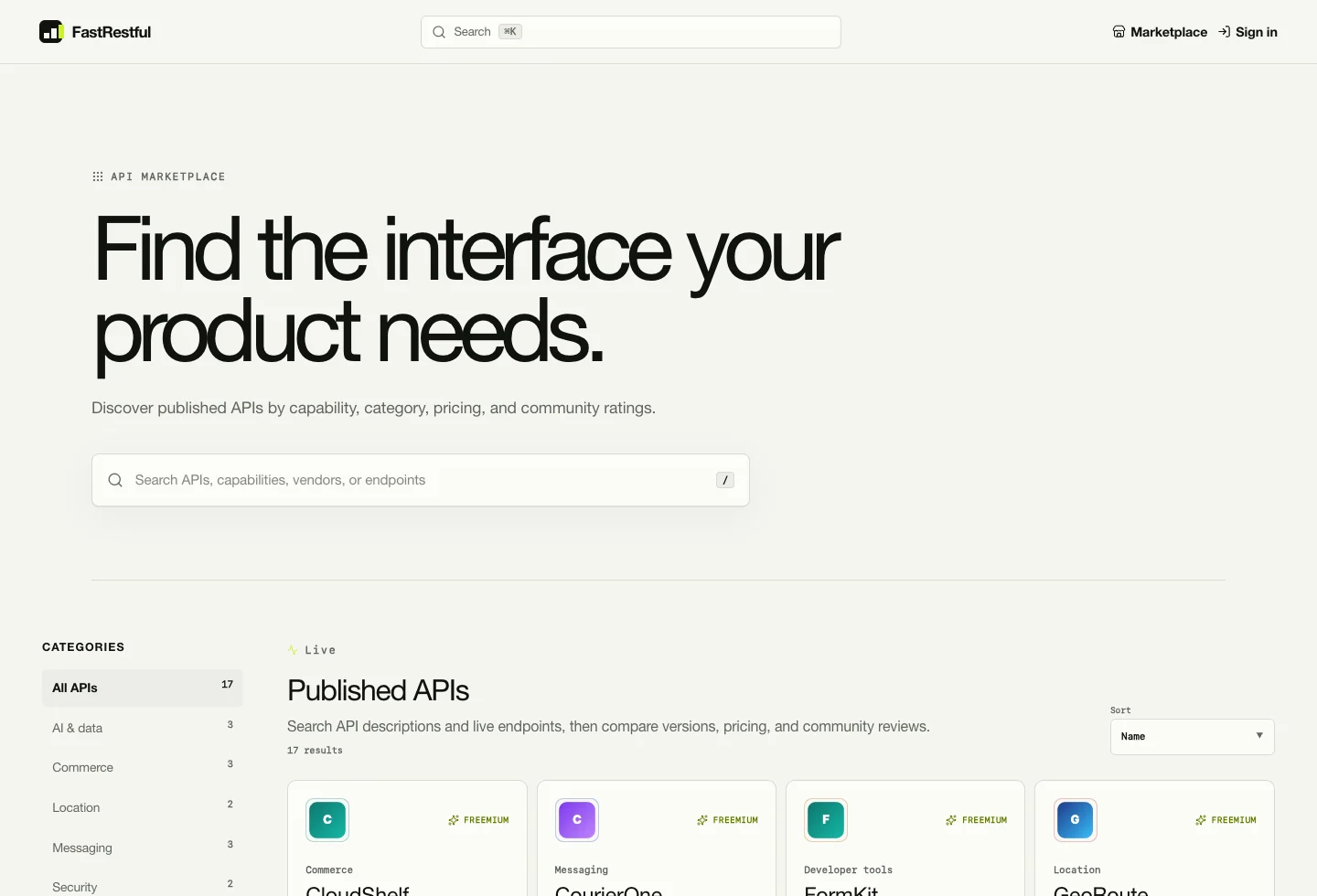
FastRestful marketplace with category filters, search, and API product cards
02 / First-party API

Turn one API into a complete product.

Publish a polished product page, version the contract, meter access, charge for plans, and support customers without building a separate billing or documentation stack.

  • OpenAPI-native releases and breaking-change diffs
  • Free, freemium, paid, trial, and overage plans
  • API keys, quotas, request logs, and customer support
  • Consumer console with apps, keys, spend, and invoices

Read the payment gateway guide

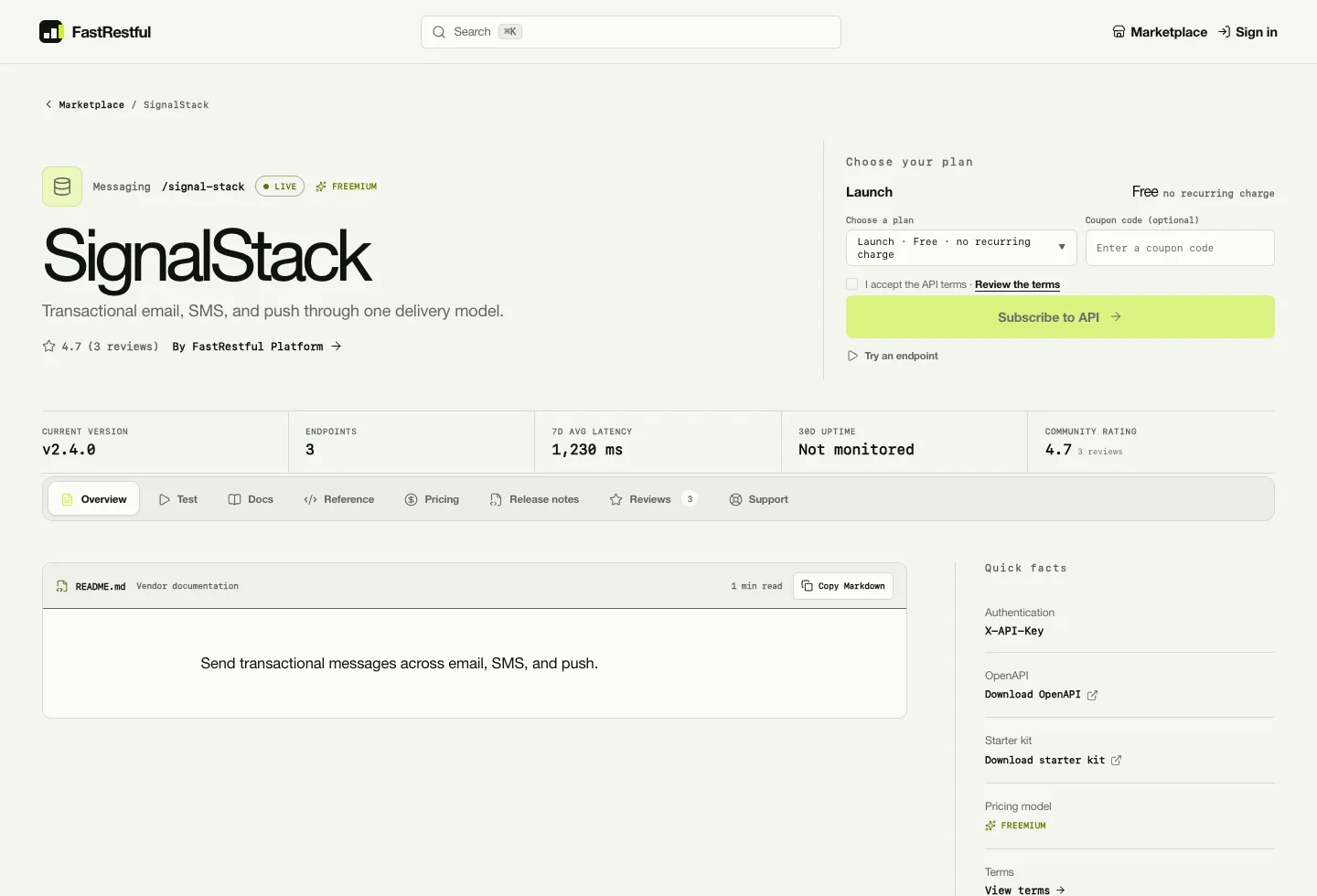
FastRestful API product page with plan selection, stats, documentation, testing, and community tabs
03 / Internal platform

Give internal teams a governed API surface.

Use workspaces, roles, scoped keys, and the same catalog to make internal APIs discoverable and accountable — without exposing private services or losing request-level evidence.

  • Tenant-scoped access and explicit workspace switching
  • Role-based publishing, billing, and support boundaries
  • SSO, SAML, two-factor, and invite-based onboarding
  • Redacted logs, usage metrics, audit, and retention controls

Read the access model

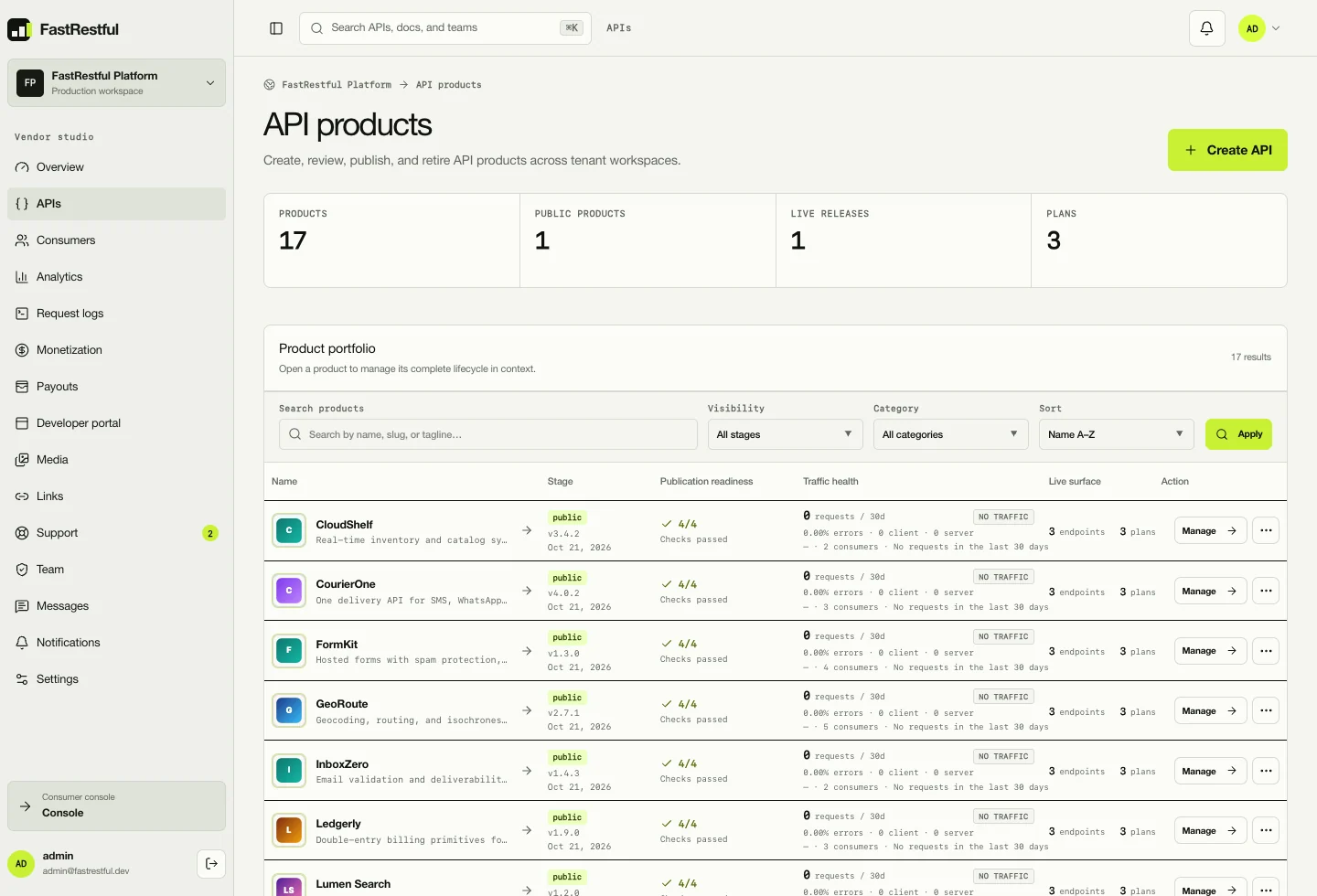
FastRestful vendor workbench for products, releases, consumers, and monetization
By team / shared truth

Every team sees its own surface, not a copy of the data.

Product, engineering, finance, support, and trust work from the same tenant-scoped records with permissions that match their job.

01Product

  • Publish a complete API listing
  • Own release notes and docs
  • Compare plan and pricing performance
  • Review community ratings and feedback
  • Manage public vendor identity
  • Ship CMS pages without a deploy

02Platform engineering

  • Import and validate OpenAPI contracts
  • Diff and promote immutable releases
  • Enforce quotas, rate limits, and entitlement
  • Inspect request logs and upstream health
  • Manage gateway and host routing
  • Operate health probes and maintenance mode

03Finance

  • Configure plans, trials, coupons, and overage
  • Reconcile provider webhooks once
  • Issue full or partial refunds safely
  • Generate invoices and payouts
  • Review MRR, revenue by provider, and refunds
  • Connect Stripe and PayPal destinations

04Support

  • Ticket threads with subscription context
  • Request-log evidence in replies
  • Vendor and consumer views of the same case
  • Priority, status, and activity ordering
  • Notification preferences and inboxes
  • Community reviews and direct messages

05Trust & safety

  • Reports, evidence, priority, and SLA
  • Appeals and independent review
  • Warnings and capability restrictions
  • User and vendor blocking
  • Policy thresholds and escalation
  • Append-only enforcement history

06Platform operators

  • Permission-aware operations overview
  • Vendor review and marketplace mode
  • Site settings, CMS, navigation, locales
  • Announcements, newsletter, links, media
  • Payment gateways and platform plans
  • Audit exports, webhooks, and notifications
Adoption path

A migration path, not a rewrite.

Start with the public surface, move one workflow at a time, and keep the old system available until the new evidence is boring.

STEP 01

Inventory.

Map products, versions, plans, keys, customers, and the actual money flows. Decide whether the first release is public, private, or internal.

  • Product and plan inventory
  • Payment and payout map
  • Role and tenant map
  • Docs and content inventory
STEP 02

Stage one surface.

Run FastRestful beside the current stack with seeded data and real contracts. Validate the catalog, gateway, and admin before moving users.

  • OpenAPI import
  • Gateway test traffic
  • Provider sandbox webhooks
  • Content preview
STEP 03

Cut over with evidence.

Move identity, keys, and billing with reversible steps. Keep provider receipts, request logs, and audit events as the source of truth.

  • DNS and TLS cutover
  • Key rotation
  • Webhook re-registration
  • Reconciliation check
Pick a starting point

Start with the surface your team needs first.

Install locally with the seeded marketplace, then choose the operating model, providers, and deployment topology that fit your business.

Self-hostedOpenAPI-nativeProvider-agnostic